/02Core Modules

Four modules. One pipeline.

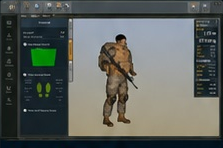
Choose from anthropometrics and configure male/female populations: body dimensions, weight, and strength characteristics.
module-warrior.png
Warrior Configuration module: soldier model beside anthropometry and strength panels
Fig. 01 — Warrior Configuration

Core modules

module-warrior.png
Warrior Configuration module: soldier model beside anthropometry and strength panels
Fig. 01 — Warrior Configuration

Warrior Configuration

Choose from anthropometrics and configure male/female populations: body dimensions, weight, and strength characteristics.

module-simbuilder.png
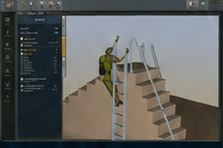
Simulation Builder module: soldier climbing a ladder beside a staircase in the task editor
Fig. 02 — Simulation Builder

Simulation Builder

Build in-environment tasks: stair and ladder ascent and descent, go prone, get up, jumps from platform, vertical jump, and more.
module-loadcarriage.png
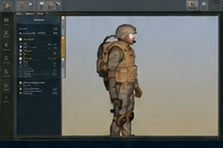
Extended Load Carriage module: loaded soldier walking in a desert environment
Fig. 03 — Extended Load Carriage

Extended Load Carriage

Model terrain, slope, speed, time of day, weather, temperature, wind, humidity, and fitness to capture real-world conditions.
module-import.png
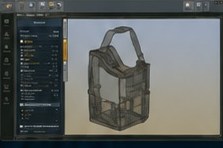
Equipment Import module: CAD pack frame with mass-property and attachment panels
Fig. 04 — Equipment Import

Equipment Import

Import CAD equipment. Define weight, center of gravity, moments of inertia, attachments, and collision/occlusion envelopes.

Analysis

Thirteen quantities. Measured, not rendered.

Support Region
Base-of-support area maintained through the task.
Ground Reaction Forces kN
Contact forces at each foot, vertical and shear.
Center of Mass mm
Whole-body COM position and offset under load.
Joint Torque N·m
Net torque demand at each joint through the motion.
Bounding Box m
Spatial envelope of the soldier plus equipment.
Cocoon Envelope (Occupant Packaging)
Clearance envelope for occupant-packaging studies.
Eye Relief mm
Eye-to-optic distance across postures.
Visibility %
Field of view retained with equipment worn.
Spine Shear & Compression kN
Shear and compressive loading on the spine.
Energy Expenditure kcal·min⁻¹
Metabolic cost of the task as performed.
Hydration L·h⁻¹
Fluid loss rate under workload and climate.
Fatigue %
Remaining capacity as the task progresses.
Thermal Assessment °C
Core and skin temperature response.